
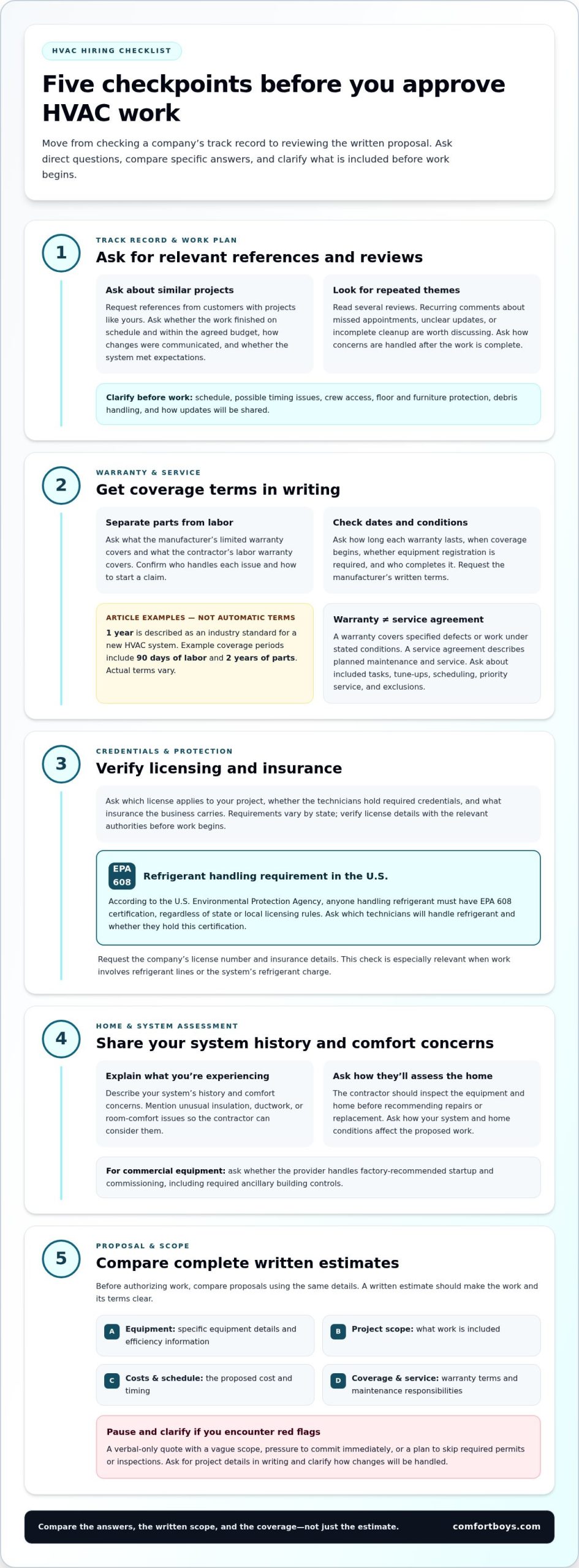
A low estimate doesn’t tell you whether an HVAC company is qualified, insured, or clear about the work. The most useful questions to ask before hiring an HVAC company cover state-required licensing, insurance, experience with your system, written project scope, and warranty terms. Requirements vary by state; according to the U.S. Environmental Protection Agency, anyone handling refrigerant in the United States must have EPA 608 certification.
It’s reasonable to want confidence that the work will be done properly and to understand what’s included before you agree. Asking direct questions helps you compare proposals, identify unclear details, and see how a company will address your home’s heating and cooling needs.
This guide covers questions about credentials, references, warranties, estimates, equipment, and project scope. Use it to assess a company’s answers and make a more informed choice for your home.
Key Takeaways
- Ask for references and look for consistent patterns in reviews; clarify how the crew will protect your home and schedule the work.
- Understand whether warranty coverage applies to parts, labor, or both, and what the service agreement includes.
- Check licensing and insurance requirements for your state. According to the U.S. Environmental Protection Agency, anyone handling refrigerant in the United States must have EPA 608 certification.
- Share your system’s history and comfort concerns so the contractor can inspect the equipment and home before recommending repairs or replacement.
- Compare written proposals for equipment details, project scope, costs, schedule, and warranty information before work begins.
1. Would you share references and reviews?
Ask the HVAC company for references from customers with projects similar to yours. If you’re replacing central equipment, prioritize references from homes with comparable systems. Ask whether the work finished on schedule and within the agreed budget, how the company communicated changes, and whether the system met expectations. These questions to ask before hiring an HVAC company help you assess relevant project experience, not just a sales conversation.
Read several customer reviews and look for recurring themes rather than focusing on one unusually positive or negative comment. Repeated mentions of missed appointments, unclear updates, or incomplete cleanup are worth discussing. Positive comments about careful installation or punctual scheduling can add context, too. Ask how the company handles concerns after the work is complete, then compare its explanation with customers’ experiences.
Clarify the installation schedule before approving the project. Ask what needs to happen before work begins, which site conditions could affect timing, and how the team will share updates. Ask how workers will access the equipment, protect floors and nearby furniture, and manage debris. These practical questions to ask before hiring an HVAC company are especially useful when equipment is near finished rooms or a narrow hallway.
Ask whether the company has experience with your HVAC system and its manufacturer. Relevant experience can help the team explain equipment requirements, compatible components, and service needs. If your home has unusual insulation, ductwork, or room-comfort concerns, describe them and ask how they affect the proposed work. For commercial equipment, ask whether the provider handles factory-recommended startup and commissioning, including required ancillary building controls.
Pay attention to how the company responds to reasonable questions. A verbal-only quote with a vague scope, pressure to commit immediately, or a plan to skip required permits or inspections are red flags. Ask for project details in writing before authorizing work. The answers should clarify the schedule, home preparation, and how changes will be handled. Compare them with references and review patterns instead of relying on one reassuring conversation.
2. What limited warranties, service agreements, and guarantees do you offer?
Before approving HVAC work, ask for warranty terms in writing and identify who handles each covered issue. A manufacturer’s limited warranty may cover parts, while a contractor’s labor warranty may address installation or service work. Ask whether the proposal includes both, what each covers, and how to start a claim. If a thermostat or another component fails, you’ll want to know whether parts coverage or labor coverage applies.
Ask how long each warranty lasts and when coverage begins. A one-year warranty is described as an industry standard for a new HVAC system, but actual terms vary. Example periods include 90 days of labor and 2 years of parts. Treat those as examples, not automatic terms for every system. Have the contractor identify the specific coverage offered for your equipment and installation.
Manufacturer terms may include separate conditions. Ask whether equipment registration is required, who completes it, and when. Request the manufacturer’s written terms and the process for warranty support. The company should explain the coverage clearly, including which work it performs and which issues fall under the manufacturer’s limited warranty. Keep the documents with your equipment’s model information for future service.
Distinguish a warranty from a service agreement. A warranty covers specified defects or work under stated conditions; an agreement describes planned maintenance and service. Ask which maintenance tasks are included, whether seasonal tune-ups are part of the plan, and how scheduling works. Some plans include priority service, so clarify whether that applies and what the agreement promises. Don’t assume routine maintenance or repairs are covered unless the terms say so.
Compare proposals by reviewing warranty coverage alongside equipment efficiency and the full project scope. A longer warranty alone doesn’t show whether a system suits your home. Ask for the equipment’s efficiency information, warranty terms, and maintenance responsibilities in one written proposal. Then compare equivalent details: equipment, parts and labor coverage, and included service. This makes differences easier to spot than comparing warranty length alone.
For ongoing maintenance questions, you can review the Comfort Service Club as one option to consider. Before joining any agreement, read its coverage, scheduling terms, and exclusions so you understand how it supports your heating and cooling needs.
3. Are you licensed, bonded, and insured?
An HVAC company should meet the licensing and insurance requirements that apply where the work takes place. Ask which license applies to your project, whether the technicians doing the work hold required credentials, and what insurance the business carries. Requirements vary by state, so verify the company’s license details with the relevant authorities before work begins.
In the United States, anyone handling refrigerant is required to have EPA 608 certification, regardless of state or local licensing rules, according to the U.S. Environmental Protection Agency. Ask which technicians will handle refrigerant in your HVAC system and whether they hold this certification. This is especially relevant when a repair or installation involves refrigerant lines or the system’s refrigerant charge.
Request the company’s license number and insurance details, then verify them with the appropriate state or local authority. Match the business name on the documents to the company preparing your proposal. If another technician or subcontractor will inspect the equipment, ask how that person’s credentials relate to the work. A clear answer helps you understand who is responsible for the job.
Ask about liability insurance and workers’ compensation coverage. Liability insurance can protect a homeowner against property damage caused during repairs. Workers’ compensation covers injuries a technician may sustain while working in a residence. Request current insurance details and clarify which business or party is covered. These questions help you determine whether the policy relates to the people and work at your home.
Bonding is separate from insurance. For larger commercial HVAC projects, a surety company can provide a bond as a financial guarantee. Ask whether the project requires a bond, who issues it, and what obligation it covers. A bond’s relevance depends on the project and applicable requirements; it is not a substitute for licensing or insurance.
Use a short verification process before approving work:
- Ask for the contractor’s license number and verify it with the relevant authority.
- Review insurance details and confirm the named business matches your proposal.
- Identify which technicians will inspect or service the system, and ask about required credentials.
- For refrigerant work, confirm EPA 608 certification.
- For a commercial project, determine whether bonding applies and what the surety bond covers.
Keep license and insurance information with your written project documents. If the proposed scope changes, such as adding refrigerant handling or bringing in another technician, reassess whether the credentials and coverage match the revised work. This helps you understand the qualifications and protections behind the company’s plan to inspect or repair your HVAC system.
4. Site surveys and repair or retrofit estimates
An HVAC estimate should describe the recommended work, itemize parts and labor, and identify additional fees. For a repair, ask what the technician found, which component needs attention, and what the proposed work addresses. For a heating and cooling retrofit, the estimate should reflect an inspection of the existing system and home, not assumptions based on equipment age alone. A written breakdown makes clear what you’re approving.
Prepare for the site survey by sharing the current system’s model information, maintenance history, and rooms that feel uncomfortable. Ask the company to inspect the air filters, thermostat, and ductwork. Leaks, kinks, or disconnected ducts can affect performance, so ask whether the inspection covers these conditions. A duct leakage test or static pressure measurement can provide useful information when airflow or uneven air conditioning is a concern.
Ask how the company will assess the existing equipment before recommending replacement. A sound assessment considers the system’s condition and your home’s needs; repair may be appropriate even when equipment is older. Ask whether existing ducting can remain in use and how its condition and compatibility affect the recommendation. For retrofit work, clarify which components will be replaced, which will remain, and whether related work falls outside the proposed scope.
Use these questions to make an estimate easier to evaluate:
- Which parts and labor are included in the repair or retrofit?
- What additional fees could apply, including emergency service or specialized parts?
- Does the estimate include site inspection or design work, and how are those charges handled?
- What conditions could change the scope, such as difficult access or concealed issues?
- Who is responsible for permits or inspections when they apply?
For commercial projects, an estimate may include site inspection, design, or upfront engineering charges. Ask how these are handled and whether they are credited against an order. It may also list allowances for difficult site access or unforeseen issues. Compare bids for equivalent services and maintenance tasks, not just similar equipment descriptions. Otherwise, a lower initial estimate may leave important work outside the scope.
Compare repair estimates by matching the listed work, parts, labor, and additional charges. You can seek multiple estimates, then ask each company to explain differences in diagnosis or scope. Clarify how changes will be approved before additional work begins and who is responsible for the agreed tasks. For commercial work, compare the same maintenance and service responsibilities across proposals. These steps help you judge what each estimate includes.
5. Written estimates, equipment details, and project scope
A written replacement proposal should clearly identify the equipment and work. Ask for model numbers, labor, permitting when applicable, miscellaneous materials, service plans, project costs, schedule, and warranty information. Before work begins, review and sign a proposal that spells out these terms. If a detail is missing, ask for it to be added so you can compare the full scope, not just a brief equipment description.
Ask how the company determined the system’s capacity. Manual J is the industry-standard method for calculating a home’s heating and cooling load. The assessment should account for the house size, insulation, windows, and total area needing heating and cooling. Ask to see the calculation and how it supports the recommended equipment. A system that’s too large can cycle on and off too often, affecting comfort and humidity control.
Equipment also needs to suit the home’s layout and installation space. Ask how the proposed model fits the available location and whether existing ducts are in good condition and compatible with the replacement system. Existing ductwork can be reused only when both conditions are met. Ask the contractor to explain what happens if the ducts need changes, so the written scope distinguishes included work from possible additions.
Compare efficiency information alongside equipment models and project details. Ask for the proposed system’s SEER rating and how its efficiency relates to expected operation. SEER is calculated by dividing the cooling released by the energy used. A higher-efficiency option may have different operating costs, so ask the company to explain any savings calculations and their assumptions. Compare equivalent equipment and installation work across proposals, not just the initial total.
Ask whether the proposed equipment qualifies for available energy-efficiency rebates and whether the company can show savings calculations. ENERGY STAR-qualified products meet energy-efficiency guidelines set by the U.S. Environmental Protection Agency. Consider rebates separately from project scope: clarify what equipment qualifies and what documentation is needed. Keep the model number and efficiency details with your signed proposal.
- Match each proposal’s model numbers, labor, materials, schedule, and warranty details.
- Review the Manual J calculation and the home factors used to size the system.
- Clarify whether existing ducts are suitable for reuse and which work is included.
- Compare SEER ratings and ask what assumptions support any savings calculations.
Planning an AC replacement? Explore AC installation options and use these scope details to prepare for a clear project discussion.
Comfort Boys Air and Heating: AC Installation
Comfort Boys Air and Heating provides AC installation and can assess whether a system needs repair. Discuss your home’s cooling needs, equipment options, installation scope, and the details to expect in a written proposal. Mini Split AC Installation may suit spaces where a ductless system is being considered. AC Repair Services and AC Tune Ups address existing systems that need attention or routine maintenance.
Use these questions to explain your comfort concerns and understand the proposed work. Contact Comfort Boys Air and Heating to discuss your AC installation needs.
Move Forward With a Clear Plan
Choosing an HVAC company involves more than approving a job. It’s also a chance to set clear expectations for supporting your home’s comfort over time. Keep your priorities in view, whether you’re planning a replacement, addressing a repair, or arranging maintenance for an existing system.
The questions to ask before hiring an HVAC company can turn a complicated decision into a practical conversation. Use the answers to explain what matters in your home and understand the proposed next step. Comfort Boys Air and Heating offers AC Installation, AC Repair Services, and AC Tune Ups, so you can discuss the service that fits your current heating and cooling needs.
If you’re ready to talk through an HVAC project, contact Comfort Boys Air and Heating. A thoughtful conversation is a good place to begin, and you can move forward with greater clarity about your home’s comfort.
Frequently Asked Questions
Are you licensed, bonded, and insured?
Ask the HVAC contractor for its license details and insurance information, then verify them with the relevant state or local authority. Requirements vary by location and project. In the United States, anyone handling refrigerant must have EPA 608 certification, regardless of state or local licensing rules, according to the U.S. Environmental Protection Agency. For a home in San Antonio or Boerne, make sure the business name on the documents matches the company doing the work.
What limited warranties, service agreements, and guarantees do you offer?
Ask which parts of the work are covered, who provides each warranty, and what steps keep coverage valid. Follow up by asking whether equipment registration is needed and who handles it. Review service agreements separately: they describe included maintenance and service terms, rather than automatically extending a manufacturer’s warranty. For example, ask whether a maintenance visit covers inspection only or also includes repairs, and keep the written terms with your equipment records.
What’s your installation timeline and process?
Ask what happens from the initial home assessment through equipment setup, testing, and the final walkthrough. Have the company explain which decisions or site conditions can affect scheduling, how updates will be shared, and what you should prepare before the crew arrives. Clarify access to the indoor unit and outdoor installation area. Comfort Boys Air and Heating serves San Antonio and nearby communities, including Boerne and New Braunfels.
Would you share references and reviews?
Ask for references from customers whose projects resemble yours, such as a replacement in a home with similar equipment. Ask how the company handled questions after installation and whether the work matched the agreed scope. Read several reviews and notice recurring comments about communication, cleanup, and follow-through. A single review offers limited context; repeated themes can suggest topics to discuss before deciding.
Will you perform a Manual J load calculation for my home?
Ask whether the company will use Manual J to calculate your home’s heating and cooling load, and request a plain-language explanation of the result. The calculation should inform equipment capacity, not simply mirror the size of the old unit. If you’ve added a room or changed insulation, mention it during the assessment. Those changes can affect the load calculation and system recommendation.
How will you evaluate my ductwork, airflow, and static pressure?
Ask what the inspection will cover and how the findings relate to comfort problems, such as a bedroom that stays warmer than the rest of the home. The company can inspect ducts for visible leaks, kinks, or disconnections and assess airflow and static pressure. Ask how those findings could affect system performance or the proposed work. If a room has persistent airflow trouble, point it out during the visit.
Which system do you recommend, and why?
Ask the company to connect its recommendation to your home’s load, existing ductwork, installation space, and comfort concerns. Request model details and efficiency information, then ask how the system’s capacity fits the calculation. A clear explanation should distinguish equipment features from assumptions about future savings. If you’re considering a ductless setup for one area, ask how that option addresses that space rather than assuming it suits the whole home.
Will you provide a detailed written estimate and scope of work?
Yes. Request a written proposal before authorizing work, with enough detail to understand exactly what the project includes. Check that it identifies equipment, labor, materials, schedule, warranty terms, and any applicable permits or service plans. Ask how proposed changes will be documented and approved. For an AC replacement, make sure the scope distinguishes work on the new equipment from changes to existing ducts or controls.