
The highest-rated filter isn’t automatically the right one for your home. For air filtration system installation in Texas, start with your HVAC equipment and household needs, not the filter label alone. A filter that captures more particles may also create airflow resistance if your system isn’t designed for it.
It’s reasonable to wonder whether a portable purifier is enough or whether an HVAC-connected system makes more sense. MERV ratings can help compare filters, but they don’t tell you whether a particular filter suits your equipment. A professional assessment can review compatibility and help you choose an approach that fits your home.
This guide explains the main whole-home filtration options, what an installation assessment considers, and how filter ratings relate to airflow. You’ll also learn what to expect from installation and how to plan a practical next step in San Antonio or the Texas Hill Country, including Boerne, Kerrville, Fredericksburg, Pipe Creek, Comfort, Spring Branch, New Braunfels, and Blanco.
Key Takeaways
- Understand how an HVAC-connected filtration system differs from a standard return-air filter and how it works with heating and cooling equipment.
- Use MERV ratings as a comparison tool, then consider filter choice alongside your HVAC system’s airflow needs and compatibility.
- See what to expect during air filtration system installation Texas homeowners may consider, from equipment assessment to installation and operation checks.
- Prepare for an HVAC assessment by noting your household’s air-quality concerns and seasonal patterns.
- Learn how Comfort Boys Air and Heating connects indoor air quality and HVAC considerations to practical next steps for San Antonio and Hill Country homeowners.
What Does Air Filtration System Installation Mean for a Texas Home?
An HVAC-connected air filtration system filters air as it moves through a home’s central heating and cooling equipment. A standard return-air filter is commonly part of an existing HVAC setup. An added filtration system may require equipment fitted into the ductwork or air handler. The right arrangement depends on the home’s system and the homeowner’s goals.
In a central system, air returns from the home through return ducts, passes through a filter as it travels toward the heating or cooling equipment, and then moves back through supply ducts into living spaces. Filtration can capture certain airborne particles, but it doesn’t address every indoor-air concern. It doesn’t remove the source of pollutants or automatically correct ventilation or humidity issues. For a general overview of Air filter types and functions, see this reference.
Whole-home filtration versus portable air purifiers
A portable purifier operates in the room where it’s placed, making it a focused option for a bedroom, office, or other space. An HVAC-connected system works with central heating and cooling equipment and circulates filtered air through the areas served by that system. Neither approach is right for every home. The choice depends on which rooms matter, the existing HVAC configuration, and what you want filtration to do.
If your concern is limited to one room, a portable unit may suit your needs. If you want filtration integrated with central heating and cooling, an HVAC-connected option may be worth assessing. Its reach depends on the equipment and ductwork serving the home.
When might a homeowner consider an installation?
Persistent dust concerns, interest in upgrading an existing filter, or a desire to explore indoor air quality options can prompt homeowners to consider installation. These are reasons to ask questions, not proof that a particular system is needed. Symptoms alone can’t diagnose an indoor-air problem or identify its source.
Before changing equipment, consider where concerns occur, when they’re most noticeable, and whether they affect one room or several. An HVAC professional can assess the system configuration and household needs before discussing suitable options. That’s a practical starting point for air filtration system installation Texas homeowners can plan with confidence: match the approach to the home rather than choosing by a filter label alone.
Which Air Filtration System Fits Your Texas Home and HVAC Equipment?
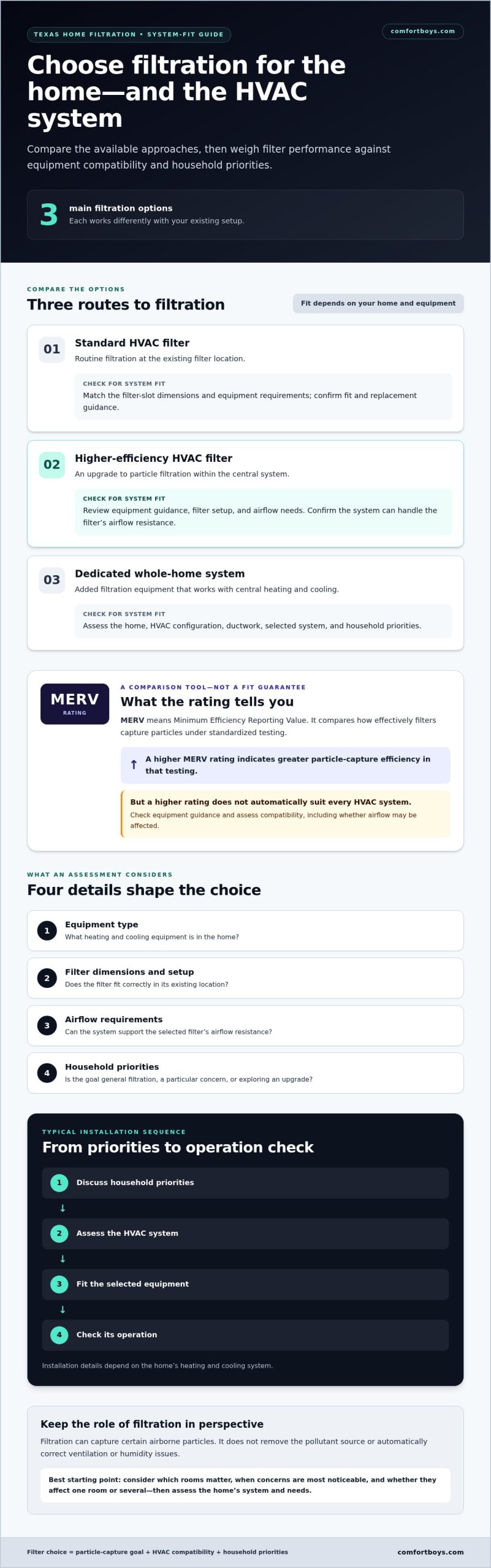
The right option depends on what you want to filter and what your heating and cooling equipment can support. Standard HVAC filters, higher-efficiency replacement filters, and dedicated whole-home filtration systems differ in how they fit into a home’s setup. For air filtration system installation Texas homeowners should compare options in context, not choose by a rating alone.
| Option | Typical application | System-fit considerations | Assessment needs |
|---|---|---|---|
| Standard HVAC filter | Routine filtration at the existing filter location | Must match the filter slot’s dimensions and the equipment’s requirements | Check filter size, fit, and replacement guidance |
| Higher-efficiency HVAC filter | Upgrading particle filtration within the central system | Confirm the system can handle the filter’s airflow resistance | Review equipment guidance, filter setup, and airflow needs |
| Dedicated whole-home system | Adding filtration equipment to work with central heating and cooling | Depends on HVAC configuration, ductwork, and the selected system | Assess the home, equipment, and household priorities |
What do MERV ratings tell homeowners?
MERV stands for Minimum Efficiency Reporting Value. It’s a rating used to compare how effectively air filters capture particles under standardized testing. A higher MERV rating indicates greater particle-capture efficiency in that testing, but it doesn’t automatically make a filter suitable for every HVAC system. Check the equipment’s filter guidance and have compatibility assessed, including whether airflow may be affected.
How do HVAC design and household needs affect selection?
An assessment should account for the equipment type, filter dimensions, airflow requirements, and how the existing filter is installed. A filter that doesn’t fit correctly or suit the system can compromise the setup. Household priorities matter, too. Consider whether your goal is general filtration, addressing a particular concern, or exploring an upgrade. These details help focus the discussion without promising a specific health outcome or measured improvement.
Texas homeowners can also use the Texas air quality regulations and monitoring resource from the Texas Commission on Environmental Quality for broader information about outdoor air. Outdoor monitoring provides context, but it doesn’t determine which indoor filtration setup fits a particular home. For local perspective, read this indoor air quality guide for Boerne homeowners. Comfort Boys provides indoor air quality services and helps homeowners connect air quality concerns with HVAC considerations through its indoor air quality services.
What Happens During Air Filtration System Installation in Texas?
A typical installation moves from discussing household priorities to assessing the HVAC system, fitting the selected equipment, and checking its operation. The details depend on the home’s heating and cooling configuration and the filtration system chosen. For air filtration system installation Texas homeowners should expect the existing equipment, airflow, access, and filter fit to guide the work.
What does the pre-installation assessment cover?
Before recommending a change, an HVAC professional reviews how the current system is arranged and what the household wants filtration to address. This makes it possible to discuss options based on the home rather than assume one setup works for everyone.
The assessment may consider:
- Existing HVAC equipment: The system type and where filtration can be added or updated.
- Current filter setup: How the filter fits, its dimensions, and equipment guidance for replacement filters.
- Airflow and access: Whether the selected approach suits the system’s airflow needs and can be reached for future filter care.
- Household priorities: The rooms or concerns you want to focus on.
These checks matter because a filter or added component needs to work with the HVAC system, not just fit physically. Considering airflow before changing filtration helps account for the equipment’s requirements.
How are installation and system checks completed?
Once the approach is selected, the equipment is placed or connected according to its design and the home’s system requirements. A professional then checks that it fits as intended and that the HVAC equipment operates with the filtration in place. The work depends on where the system connects and how the home’s equipment is configured.
After installation, make sure you know how to access and care for the filter. Follow the equipment instructions for the correct replacement type and maintenance guidance. A properly seated filter that’s maintained as directed is easier to manage as part of routine home care.
The process is straightforward: discuss your goal, assess the HVAC setup, choose a compatible approach, install it, and check fit and operation. This gives you a clear view of what the work addresses before it begins, while allowing the installation to suit your home.
How Can San Antonio and Hill Country Homeowners Plan for Filtration?
For homeowners in San Antonio and the Texas Hill Country, a useful filtration plan starts with the home’s HVAC setup and the concerns they want to address. Seasonal changes may affect when dust or comfort issues are most noticeable, but those observations don’t identify the cause on their own. Bring them to an assessment so the discussion can focus on your equipment, filter fit, and household priorities.
What should homeowners prepare before an assessment?
A few notes can make the conversation more focused. Gather available information about your heating and cooling equipment, and check the size or type printed on the current filter. You don’t need to diagnose a problem; simply describe what you’ve noticed and when.
- Equipment details: Note the system type or information available on its label or paperwork.
- Current filter: Record its size and type, or take a photo of the label.
- Location: Note which rooms have dust or comfort concerns, and whether the issue comes and goes with the season.
- Priorities: List what you’d like to explore, such as an appropriate filtration upgrade or options for the areas served by your central system.
These details help an HVAC professional connect your observations with the home’s configuration. They’re a starting point for assessment, not a diagnosis or proof that a specific filtration change is needed.
How does ongoing HVAC care support filtration?
After installation, follow the equipment and filter manufacturer’s guidance for care and replacement. A correctly selected system still needs routine attention, and the appropriate maintenance instructions depend on the equipment and filter in place. For ongoing system care, see HVAC maintenance in San Antonio.
Filtration installation, duct cleaning, and routine HVAC maintenance address different parts of home comfort. Filtration adds or updates equipment that captures particles as air passes through the system. Duct cleaning focuses on the ductwork, while maintenance supports the operation of heating and cooling equipment. If your concern is specifically about ductwork, learn more about professional air duct cleaning in San Antonio.
Ready to discuss filtration alongside your HVAC setup? Explore indoor air quality support with Comfort Boys and plan a practical next step for your home.
Choose a Local Partner for Air Filtration System Installation
A filtration recommendation should make sense for both your indoor air quality goals and the HVAC equipment already in your home. Comfort Boys provides air filtration system installation and indoor air quality services, helping homeowners connect those considerations with their heating and cooling systems. The goal is a practical next step based on your home, system, and priorities, not a one-size-fits-all recommendation.
Why does local HVAC experience matter for this project?
Comfort Boys is a family-owned HVAC company serving San Antonio and Texas Hill Country communities, including Boerne, Kerrville, Fredericksburg, Pipe Creek, Comfort, Spring Branch, New Braunfels, and Blanco. Reviewing how a home’s equipment is configured helps put filtration choices in context, including system compatibility, airflow, equipment operation, and day-to-day comfort.
That matters because the filter or added equipment needs to work with the HVAC system, not just match a preferred rating. A home-specific discussion can account for the existing setup and the concerns that prompted your search. For more background, explore this indoor air quality services guide.
What is a sensible next step for homeowners?
Start with a brief description of what you want filtration to address and what you know about your HVAC setup. Details such as the current filter size, where you notice dust, or which rooms you want to prioritize can make the conversation more useful. You don’t need to arrive with a diagnosis or a specific system in mind.
Comfort Boys can connect those priorities with HVAC and indoor air quality considerations, then discuss suitable next steps for your home. Whether you’re exploring an upgrade or trying to understand your options, the recommendation should reflect your equipment and household needs rather than assume the same solution fits every property.
For air filtration system installation Texas homeowners can plan with greater confidence, begin with the home’s existing system and a clear conversation about your goals. Contact Comfort Boys to discuss indoor air quality and home comfort for your San Antonio or Hill Country home.
Plan a Filtration Approach That Fits Your Home
Effective filtration planning starts with your HVAC system and the concerns you want to address, not a filter rating in isolation. When considering air filtration system installation Texas homeowners should weigh filter efficiency alongside equipment compatibility and airflow. The right option depends on the home’s setup and household priorities.
A portable purifier serves the room where it operates, while HVAC-connected filtration works with a central heating and cooling system. An assessment can help clarify which approach fits your goals and what installation involves. Routine filter care matters, too, so follow the guidance for your equipment and filter.
Comfort Boys is a family-owned HVAC company serving San Antonio and the Texas Hill Country, with residential indoor air quality and HVAC services. The team can connect your air quality concerns with your home’s equipment and discuss practical next steps.
Talk with Comfort Boys about air filtration for your home. A thoughtful plan can make your next step clear and manageable.
Frequently Asked Questions
What is an air filtration system installation?
An air filtration system installation adds or updates equipment that filters air as it moves through a home’s heating and cooling system. It may involve a replacement filter or filtration equipment connected to the HVAC system, depending on the setup. This differs from a portable purifier, which treats air in the room where it operates. The right approach depends on the home’s equipment, filter arrangement, and indoor air quality priorities.
Is a whole-home air filtration system better than a portable air purifier?
Neither option is universally better. The choice depends on the rooms and goals you want to address. A portable purifier operates in a specific room, such as a bedroom or office. HVAC-connected filtration works with a central system and serves the areas that system reaches. Consider whether your concern is limited to one space or whether you want filtration integrated with central heating and cooling.
Can a high-MERV filter damage an HVAC system?
A high-MERV filter can restrict airflow if the HVAC system isn’t designed to handle its resistance. That doesn’t mean every higher-rated filter will damage equipment, but choosing by rating alone can overlook system requirements. Check the equipment’s filter guidance and have compatibility assessed before upgrading. The filter’s dimensions, fit, and the system’s airflow needs all matter when deciding whether a particular option is suitable.
How long does air filtration system installation take?
Installation time varies with the home’s HVAC configuration, the filtration equipment selected, and the access available at the installation location. Replacing a filter and adding connected equipment are different scopes of work, so there isn’t one duration that applies to every home. An assessment helps define the work involved and provide a project-specific expectation. A general estimate may not reflect the system or installation approach.
Does installing an air filtration system replace regular HVAC maintenance?
No. Filtration installation adds or updates equipment that captures particles as air passes through the system, while HVAC maintenance supports the ongoing operation of heating and cooling equipment. Both are separate parts of home care. Follow the manufacturer’s guidance for maintaining the HVAC system and replacing or caring for its filter. An HVAC professional can help relate the guidance to your setup.
Can an air filtration system help with dust in a Texas home?
An air filtration system may capture some airborne particles, including dust, as air passes through its filter. The result depends on the filter, its fit, and the HVAC system. Filtration won’t identify or remove every source of dust, so note which rooms are affected and when you notice the concern. In San Antonio or the Hill Country, those observations can help guide a home and equipment assessment without treating dust as a diagnosis.
Do I need a professional to install an HVAC-connected air filtration system?
Professional assessment and installation are a sensible choice for equipment connected to central heating and cooling. A technician can review the HVAC configuration, filter fit, access, and airflow considerations before installing and checking the system. Comfort Boys is a family-owned HVAC company serving San Antonio, Boerne, Kerrville, Fredericksburg, Pipe Creek, Comfort, Spring Branch, New Braunfels, and Blanco. Contact Comfort Boys to discuss air filtration system installation for your home.