
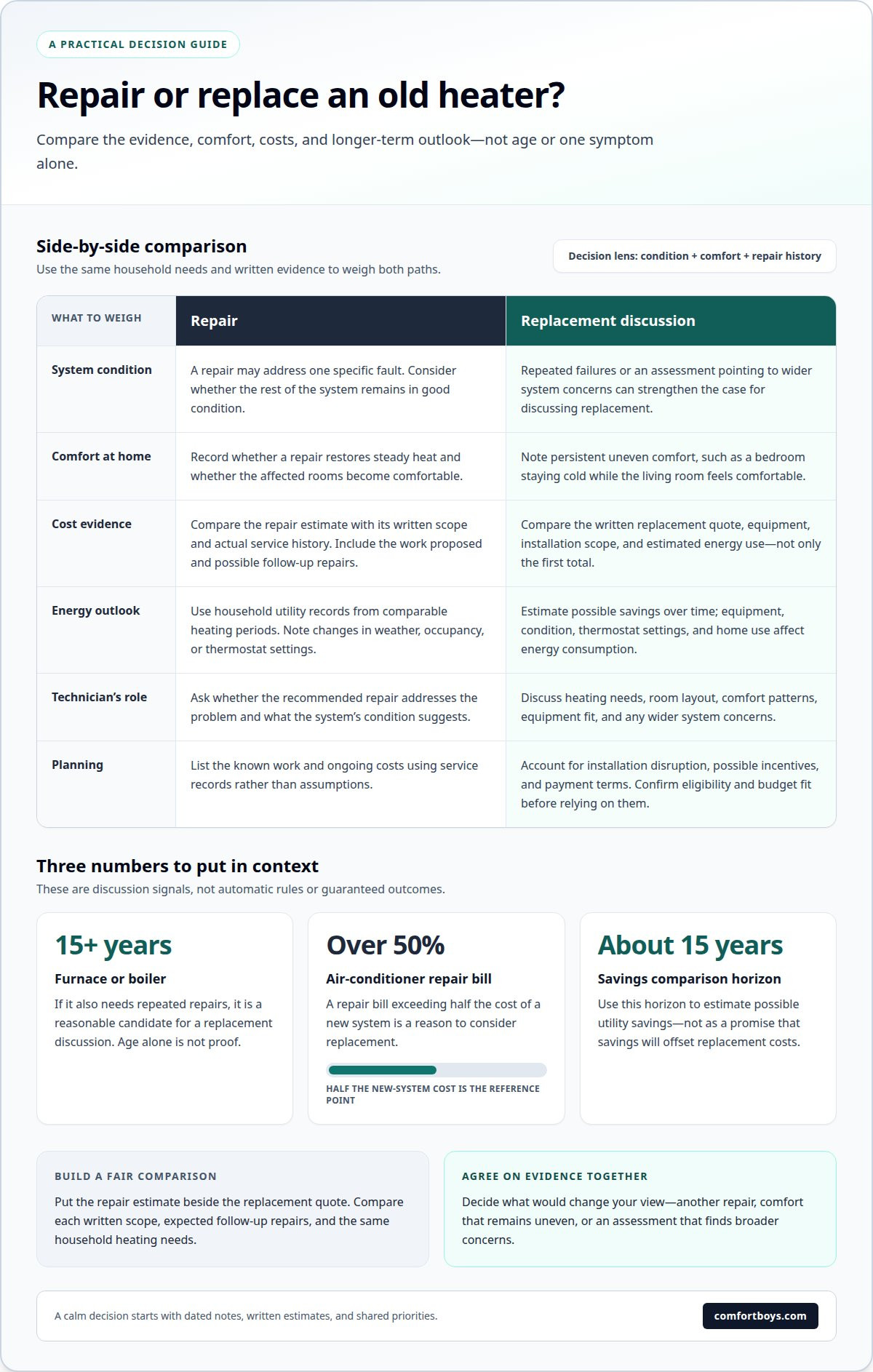
An old heater doesn’t need replacing just because it’s old, but repeated breakdowns and uneven comfort can make a stronger case. To convince your spouse to replace an old heater, document which rooms feel uncomfortable, when problems occur, past repairs, and what a technician finds. A furnace or boiler more than 15 years old that needs repeated repairs is a reasonable candidate for a replacement discussion.
It’s understandable to want clear evidence before agreeing to a major home decision. A calm conversation backed by notes can help you focus on the heater’s condition and your household’s comfort, rather than on frustration after another failure. This article explains what to record, how to weigh repair against replacement, and how a technician can help assess possible energy savings. You’ll also see how to bring the information into a practical conversation with your spouse, so you can decide together whether keeping the current system still makes sense.
Key Takeaways
- Record which rooms feel uncomfortable, when the issue happens, and the heater’s repair history to make the conversation specific.
- Weigh the system’s overall condition, recurring repairs, household comfort, and repair findings rather than relying on age or one symptom alone.
- Compare possible utility savings over a longer ownership horizon, taking equipment efficiency and how the home is heated into account.
- A technician’s assessment can clarify whether a repair addresses the problem or whether broader system concerns deserve discussion.
- ENERGY STAR recommends considering replacement when a heat pump or air conditioner is more than 10 years old.
What are the signs an HVAC system needs replacement rather than repair?
One symptom or an older installation alone doesn’t prove replacement is necessary. Use repair history, comfort problems, the system’s condition, and household priorities to guide the decision.
- Keep a simple record of each heating problem. Note the date, affected rooms, thermostat setting, and what happened, such as a bedroom staying cold while the living room feels comfortable. Add each service visit and the issue addressed. A dated record helps both spouses discuss recurring patterns instead of relying on different memories.
- Write down the system type and approximate age before discussing replacement. A furnace or boiler more than 15 years old that needs repeated repairs is worth discussing as a replacement candidate. An old heater alone isn’t proof; the condition, repair history, and comfort problems still matter.
- Compare the latest repair recommendation with the system’s condition. For an air conditioner, a repair bill exceeding 50% of a new system’s cost is a reason to consider replacement. Repeated breakdowns also matter: a single repair can solve a specific fault, while recurring failures can point to broader concerns.
- Choose a calm moment, not the middle of a cold night or just after a breakdown. To convince your spouse to replace an old heater, share your notes and explain the practical concern, such as repeated service visits or rooms that never reach a comfortable temperature. Ask what matters most to them, whether that’s reliability, comfort, or keeping the current system.
- Choose a heating option that suits your home’s needs with a technician’s assessment. Efficiency depends on the equipment and how well it fits the home, so discuss heating needs, room layout, and comfort patterns together. A system suited to a smaller home may not meet the needs of a larger one.
- Check possible federal, state, and local rebates or tax credits against the replacement equipment and your location. Eligibility depends on current rules and the system selected. Treat any incentive as a separate budget item rather than counting on it before confirming that your household qualifies.
- Discuss installation disruption before deciding. The work involves removing existing equipment, installing the replacement, and testing it. Access to the heater, equipment location, and any needed changes affect the process. Ask the technician what to expect in your home and how long the installation is scheduled to take.
- Talk through how your household would pay before treating replacement as the only option. Possible approaches include using savings or financing through a lender. Compare repayment terms, fees, and total amount repaid, then consider whether those terms fit the household budget alongside expected comfort and energy use.
Expected utility savings and comparison horizons
Compare the full ownership picture, not just the next repair or replacement estimate. Taking a longer view can help you and your spouse discuss value without treating savings as certain.
-
Compare Repair and Replacement Costs
Put the repair estimate beside the replacement quote, then compare what each covers: proposed work, equipment, installation scope, and expected follow-up repairs. Don’t judge by the first total alone. A repair may address one fault, while replacement changes the system. Review each written scope and the technician’s relevant qualifications and experience, and ask what assumptions explain differences between estimates.
-
Consider Savings Over Time
Use about 15 years as a comparison horizon for possible utility savings, not as a promise. Estimate whether expected bill changes over that period could offset replacement costs, and include the current system’s repair history. Compare the same household and heating needs in both scenarios. Don’t count projected savings as guaranteed income; equipment, condition, thermostat settings, and home use affect energy consumption.
- Build two clear scenarios for your household. For repair, list the known work and likely ongoing costs, using actual service records rather than assumptions. For replacement, include the written installation scope and estimated energy use. For example, a repair that restores steady heat may make sense if the rest of the system remains in good condition. Recurring problems can change that calculation.
- Separate utility savings from other benefits. Replacement may provide more consistent comfort or fewer interruptions, even if those improvements don’t lower bills. Write down which outcome matters most to each spouse. Then compare the options against those priorities instead of treating energy savings as the only reason to replace equipment.
- Use household utility records to make estimates relevant. Review bills from comparable heating periods and note changes in thermostat settings, occupancy, or weather that could affect energy use. A before-and-after comparison is more meaningful when household habits stay similar. If they change, note that alongside the figures rather than attributing every bill difference to new equipment.
- Agree on what evidence would change the decision. You might revisit replacement if another repair is needed, comfort remains uneven, or an assessment identifies wider system concerns. Set that decision point together before the next breakdown. This gives both spouses a practical way to evaluate new information without turning each repair into a fresh argument.
Evaluating possible energy savings
Estimate energy savings using your home’s actual heating use, the proposed equipment, and realistic operating habits. ENERGY STAR figures offer context, but your household’s comparison should reflect its own system and conditions.
- Gather utility bills from comparable heating periods before estimating a change. Note the fuel type, seasonal usage, thermostat settings, and any major shifts in occupancy. For example, a warmer winter or a lower thermostat setting can reduce usage without an equipment change, so don’t treat every bill difference as a gain in heater efficiency.
- Ask the technician to compare the existing system’s condition and efficiency with the proposed equipment. For a gas furnace, AFUE describes the share of fuel converted directly into heat for the home. An 80 AFUE furnace converts 80% into home heat, while a 97% AFUE furnace converts 97%.
- Use ENERGY STAR benchmarks as context, not as a prediction for your bills. ENERGY STAR says correctly installed, high-efficiency, ENERGY STAR-labeled units can save up to 20% on heating and cooling costs. The potential result depends on the equipment, its installation, the home, and how the household operates the system.
- Check the proposed system’s qualification and compare like with like. An ENERGY STAR-qualified furnace is 15% more efficient than a conventional furnace. An ENERGY STAR-qualified boiler is 5% more efficient than a new standard model. Those comparisons describe equipment efficiency, not a guaranteed reduction in a particular household’s bill.
- Ask how the estimate accounts for your home’s heating needs. Insulation, air leakage, thermostat settings, and room use affect how much energy the system consumes. For example, a household that heats fewer rooms or changes its thermostat routine may see different usage from one that maintains steady settings.
- Compare projected savings over about 15 years, while keeping that horizon separate from a promise. Set the estimated energy use beside replacement and operating costs, then consider the current system’s repair needs. A longer comparison can clarify the trade-off, but changing energy prices and household habits influence the outcome.
- Use the U.S. Environmental Protection Agency’s Home Energy Yardstick as another point of reference. A score below five indicates that a home’s energy use is above average. Treat that score as a reason to examine household energy use, not proof that replacing the heater alone will lower bills.
- Ask the technician to explain the assumptions behind projected savings, including equipment efficiency and expected use. Have the estimate distinguish energy savings from comfort improvements. That breakdown gives both spouses a clearer basis for comparing options and avoids presenting projected bill changes as the only measure of value.
Getting a technician’s assessment
A technician’s findings can turn recurring heater concerns into a clearer repair-or-replacement discussion. Use these steps to make the assessment useful for both spouses.
- Share a concise history before the inspection begins. Include recurring breakdowns, service visits, and rooms with uneven comfort. For example, explain that the back bedroom stays cold while the living room warms normally. This helps connect the heater’s operation to the problem your household experiences.
- Describe when each issue occurs. Tell the technician whether the problem appears during startup, after the heater runs, or only in certain rooms. Include thermostat settings and changes you’ve noticed. Specific examples help distinguish a repeated comfort complaint from a single event that has already been resolved.
- Ask the technician to explain the diagnosis in plain language. Find out what is causing the current fault, which repair would address it, and whether other system concerns affect the recommendation. If the issue is limited, understand how the proposed repair addresses it. If concerns are broader, ask which findings support discussing replacement.
- Request a clear comparison of the repair and replacement options. The assessment should distinguish the immediate repair from any wider work recommended for the existing heater. Ask what each option is intended to solve and what conditions could lead to another service visit. This gives you and your spouse a more useful basis for weighing the choices.
- Ask the technician to connect the findings to your home’s comfort concerns. If one room stays cold, ask whether the diagnosis links that symptom to the heater or identifies another cause. A symptom alone doesn’t establish that the entire system needs replacement. Knowing what the assessment does and doesn’t explain keeps the discussion grounded.
- Record the technician’s conclusions while they’re fresh. Note the diagnosed problem, recommended repair, broader concerns, and the reason for any replacement recommendation. Keep those findings beside your repair history. When you review them together, focus on evidence, such as repeated failures or unresolved comfort issues, rather than assumptions about the heater.
- Discuss the findings with your spouse after the visit, not during a stressful breakdown. Compare the technician’s explanation with your household priorities, such as reliable heat in every room and fewer recurring repairs. If the diagnosis supports repair, consider that route. If it identifies wider system concerns, use those specific findings to decide whether replacement deserves further discussion.
HVAC system age and typical lifespan
Age helps frame a replacement discussion, but the system’s condition and repair history matter too. Use these steps to put the installation date in context.
- Find the heater’s installation date or model information before comparing options. Check household records, equipment labels, or past service paperwork. If the date isn’t clear, ask a technician to help identify the system’s age. A reliable estimate gives you and your spouse a shared starting point.
- Match the age guideline to the equipment type. ENERGY STAR recommends considering replacement when a heat pump or air conditioner is more than 10 years old. For a furnace or boiler, replacement is worth considering when it’s more than 15 years old, particularly if repairs are recurring.
- Use typical lifespan as context, not a deadline. A central air conditioning system typically lasts 15 to 20 years. Its actual condition, maintenance, and operating history still matter. For example, a system approaching that range with repeated faults may call for a closer repair-versus-replacement review.
- Look beyond the age and note the system’s recent pattern. A heater that has needed repeated repairs presents a different decision from one with a single isolated problem. Compare repair history with comfort concerns and the technician’s findings. That combination gives age practical meaning for your household.
- Separate age guidance for heating equipment from air-conditioning lifespan information. A central AC system’s typical 15-to-20-year lifespan doesn’t establish a furnace’s lifespan. Identify whether your home uses a furnace, boiler, heat pump, or separate cooling system before applying an age recommendation.
- Discuss what the age means for your household rather than treating it as an automatic replacement rule. Ask whether the current system meets your comfort needs and whether the repair recommendation addresses the diagnosed problem. A spouse may reasonably favor repair if the equipment works reliably and the issue is limited.
- Use the technician’s assessment to connect age with condition. Ask which findings support repair and which point to broader concerns. A system’s age alone doesn’t explain uneven temperatures or repeated faults. Pair the assessment with its service history so both spouses can weigh the same evidence.
- If age and recurring problems make the choice difficult, discuss your heater’s condition with a technician. Bring the installation information and repair records. A clear review can help you understand whether the current system’s condition supports another repair or a replacement discussion.
Comfort Boys Air and Heating: Heater Repair
Comfort Boys provides Heater Repair for homeowners dealing with a malfunctioning or unreliable heating system. If the assessment points to a repairable fault, repair can address that problem without making replacement the automatic next step. If recurring issues or broader system concerns remain, use those findings to continue your household’s repair-versus-replacement discussion.
Share the symptoms you’ve noticed and the system’s repair history when arranging service. Clear details help focus attention on the heating problem that prompted your decision. Contact Comfort Boys Air and Heating to discuss your heater repair needs.
Make your next step a shared decision
A heater decision doesn’t have to become a contest between caution and urgency. If you’re trying to convince your spouse to replace an old heater, make the next conversation about what would help you both feel comfortable moving forward. Agree on what information you still need, then decide together whether repair or replacement best fits your home and priorities.
Comfort Boys also offers AC Installation, AC Repair Services, and AC Tune Ups for homeowners planning broader HVAC care. For a heating concern, Heater Repair can help address a malfunctioning system. A technician’s assessment can give your household a practical starting point for choosing what comes next.
Contact Comfort Boys Air and Heating to discuss your heater concerns and take the next step together. A calm, informed conversation can help you make a choice that feels right for your home.
Frequently Asked Questions
Which signs are worth documenting before you talk?
Record recurring breakdowns, service visits, unusual operating changes, and rooms that feel too warm or cold. Note when each problem happens and the thermostat setting, such as a back room staying chilly overnight despite steady heating elsewhere. These observations help you convince your spouse to replace an old heater through a shared discussion of household needs, rather than a disagreement based on different memories.
How long do furnaces, air conditioners, and heat pumps typically last?
Age recommendations differ by equipment type, and they’re not guarantees of a system’s lifespan. ENERGY STAR recommends considering replacement when a heat pump or air conditioner is more than 10 years old. A central air conditioning system typically lasts 15 to 20 years. For any system, maintenance, condition, and repair history help explain whether it remains suitable for the home.
What health, comfort, and safety risks can an aging HVAC system cause?
An older HVAC system can become less dependable or struggle to maintain comfortable temperatures, but age alone doesn’t establish a health or safety hazard. Record specific concerns, such as recurring outages or rooms that remain uncomfortable, and include them in a technician’s assessment. For homeowners in San Antonio, Boerne, Comfort, Fredericksburg, Spring Branch, New Braunfels, Blanco, Kerrville, and Pipe Creek, the system’s condition and the home’s heating needs matter more than age by itself.
What are the signs an old heater needs replacement?
Consider a replacement discussion when a furnace or boiler is more than 15 years old and needs repeated repairs. Other relevant factors include recurring breakdowns, persistent comfort problems, and the technician’s assessment of the system’s overall condition. One fault or an older installation alone doesn’t settle the decision. Compare the specific repair recommendation with broader system concerns before deciding together.
How much does it cost to replace a home heating system in the US?
Replacement cost depends on the equipment selected, the home, and the installation work required. A furnace replacement for a straightforward setup won’t necessarily involve the same scope as a project requiring changes to existing equipment or connections. The price depends on the case and is given after a quote request; system type, home layout, and installation scope affect the estimate.
How much can a new energy-efficient heater save on utility bills?
ENERGY STAR says correctly installed, high-efficiency, ENERGY STAR-labeled units can save up to 20% on heating and cooling costs. That figure is a potential maximum, not an estimate of a particular household’s bill. Actual energy use also reflects equipment condition, thermostat settings, and how the home is heated. Compare projected use for your household, rather than assuming the benchmark will match your savings.
What is the average lifespan of a furnace, boiler, and heat pump?
ENERGY STAR recommends considering replacement for a furnace or boiler more than 15 years old, and for a heat pump more than 10 years old. These are replacement considerations, not fixed expiration dates. A system’s maintenance, condition, and repair pattern provide additional context. Use the equipment’s age as one part of the decision, alongside the technician’s findings and your household’s comfort.
What are the safety risks of an aging heater, including carbon monoxide and fire?
Age alone can’t establish whether a heater presents a carbon monoxide or fire risk. If you’re concerned about either issue, describe the specific observation to a qualified technician and ask for an assessment of the equipment’s condition. Don’t treat normal operation or a certain age as proof of safety. A diagnosis can help clarify whether the system needs repair or warrants broader discussion.