
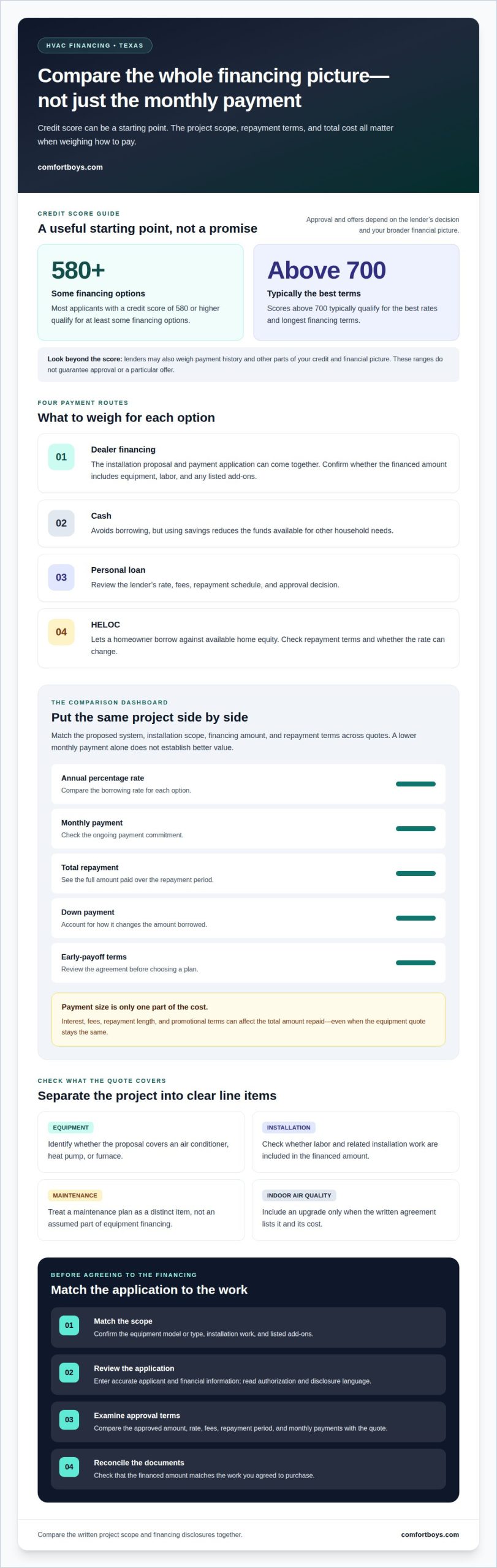
A less-than-perfect credit score doesn’t automatically put HVAC financing out of reach. For HVAC system payment plans in Texas, most applicants with a credit score of 580 or higher qualify for at least some financing options. Scores above 700 typically qualify for the best rates and longest financing terms.
It’s understandable to focus on the monthly payment when a heating or cooling system needs attention. But the right way to pay also depends on the full financing terms, whether you can make a down payment, and how quickly you want to repay the balance. A manageable payment should fit your budget without obscuring the total cost.
This guide compares dealer financing with paying in cash, using a personal loan, or tapping a home equity line of credit. You’ll also learn what credit factors may affect approval and how down payments and early payoff can shape your choices. With those details in view, you can compare options more confidently and decide which approach fits your household.
Key Takeaways
- Compare the total repayment cost and monthly commitment, not just the payment amount, when weighing financing against cash or borrowing options.
- Understand how the application process and your credit profile can affect the financing terms available to you.
- Consider how a down payment changes the amount you borrow, and review early-payoff terms before choosing a plan.
- Look beyond your score alone: lenders may consider other parts of your credit and financial picture.
- Once you’ve settled on a payment approach, explore AC installation options that fit your home’s comfort needs.
Dealer financing compared with cash, personal loans, and HELOCs
Compare HVAC quotes by matching the proposed system, installation scope, financing amount, and repayment terms. Then compare the annual percentage rate, monthly payments, total repayment, down payment, and early-payoff terms for each option. This side-by-side view helps show whether a lower payment comes with a longer repayment period or higher borrowing cost.
Dealer financing can bring the installation proposal and payment application together. Qualifying HVAC financing can include both equipment and labor costs, so review how the agreement accounts for each. For an air conditioner, heat pump, or furnace, compare the equipment specifications and installation work being financed, not just the amount borrowed. Ask yourself whether the proposed system meets the home’s heating or cooling needs before focusing on the payment.
Cash avoids borrowing, but using savings reduces the funds available for other household needs. A personal loan offers another way to pay, with its rate, fees, repayment schedule, and approval decision set by the lender’s terms. A HELOC lets a homeowner borrow against available home equity. Review its repayment terms and whether its rate can change, since those details affect the cost over time.
Financing terms can also shape how you handle related work. An indoor air quality upgrade or maintenance plan may be included only when the financing agreement lists it. Treat each item as a separate line on the proposal, then compare the financed amount with the work included. This makes it easier to see whether the payment covers equipment alone or combines several project elements.
- Equipment: Identify whether the proposal covers an air conditioner, heat pump, or furnace.
- Installation: Check whether labor and related installation work are part of the financed amount.
- Maintenance: Look for a maintenance plan as a distinct item, not an assumed part of equipment financing.
- Indoor air quality: Include upgrades only when the written agreement lists them and their cost.
For a practical comparison, use the same project scope across each quote. A lower monthly payment alone doesn’t establish better value; the repayment period and total amount paid matter too. Keep the proposal and financing terms together so you can compare equipment, installation, and optional items consistently.
Can financing affect HVAC pricing?
Financing can affect the total amount repaid, even when the equipment quote stays the same. Interest, fees, repayment length, and any promotional terms determine how the financed balance spreads across monthly payments. Compare the written installation price with the lender’s repayment schedule to see the full cost.
For Texas consumer protections, review the signed sales agreement and financing disclosures together, and keep copies of both. Compare the written scope, payment obligations, and cancellation language before signing; applicable protections depend on the transaction and governing rules.
Texas utility rebates or energy-efficiency incentives depend on the program, equipment, and eligibility requirements. Count an incentive in your budget only after confirming its terms and how it applies to the proposed installation.
Renters and landlords should distinguish who is applying for credit from who owns the equipment. Who applies for financing and who owns the equipment are separate considerations, so review the agreement and related responsibilities before proceeding.
Timing matters. If an air conditioner, heat pump, or furnace may need replacement, begin comparing quotes before a breakdown forces a rushed decision. A completed application can’t establish the project scope; get the equipment and installation details first, then compare financing for that specific work.
Service Finance may appear by name in a contractor’s financing materials. Treat its application and approval terms as distinct from the equipment proposal. Read the lender’s disclosures for the amount financed, rate, payment schedule, fees, and any conditions attached to promotional terms. A contractor’s quote describes the project; the financing agreement explains repayment.
Use this sequence to compare an application with the proposed work:
- Match the scope. Confirm the equipment model or type, installation work, and any listed add-ons.
- Review the application. Enter accurate applicant and financial information, then read the authorization and disclosure language.
- Examine approval terms. Compare the approved amount, rate, fees, repayment period, and monthly payments with the quote.
- Reconcile the documents. Check that the financed amount matches the work you agreed to purchase.
Seasonal planning is about preparation, not assuming a particular discount. An application started before urgent replacement gives you time to compare equipment proposals and financing terms without treating approval as a substitute for reviewing the contract.
Before signing, ask whether the quoted price changes with the selected payment method, and separate any lender charges from installation charges. That distinction shows whether financing changes the project price, the repayment cost, or both.
What credit score is needed for HVAC financing?
Most applicants with a credit score of 580 or higher qualify for at least some financing options. Scores above 700 typically qualify for the best rates and longest financing terms. These ranges offer a starting point, not a promise of approval or a particular offer.
A credit score is one part of a lender’s decision. The lender may also weigh payment history, current debt, income, credit history, and the amount requested. For example, two applicants with the same score can receive different decisions if their existing obligations or repayment records differ. The financing amount and proposed monthly payment also matter because they show how the new debt fits the applicant’s finances.
Before applying, review your credit reports and correct any errors through the appropriate reporting process. Then compare the application details with your current finances. Use accurate income, debt, and housing information; an incomplete or inconsistent application can complicate the review. Avoid taking on new debt while comparing offers, since a new account can affect the lender’s assessment.
A score below 580 doesn’t tell the whole story, but it can limit available options. A score over 700 can improve access to favorable terms, yet the lender still reviews the full application. If one application is declined, identify the stated reason before submitting another. This helps you address a specific issue rather than applying repeatedly without a plan.
- Review: Check your credit reports for errors before starting an application.
- Prepare: Gather accurate income, debt, and housing details for the lender’s questions.
- Compare: Look at the offered rate, term, fees, and monthly payment, not only the approval decision.
- Plan: Choose a payment amount that remains manageable alongside existing obligations.
Federal tax credits or rebates are separate from credit approval. Their effect on your HVAC budget depends on program eligibility and how the incentive is paid; don’t assume it will automatically reduce the amount financed. Keep the financing decision and any potential incentive in separate calculations so the monthly obligation remains clear.
For example, an applicant with a 580 score should compare the terms actually offered with the project amount and household budget. An applicant above 700 can still benefit from comparing offers, because a higher score alone doesn’t establish the best total repayment cost. In both cases, review the full agreement before accepting financing.
Down payments and early payoff
A down payment reduces the amount financed, while early payoff can shorten the time you carry the balance. Before accepting HVAC financing, compare the required upfront amount, remaining principal, payment schedule, and rules for paying ahead. Those details show how much cash you need now and how extra payments affect your obligation.
For example, compare two offers for the same installation scope: one requires a larger upfront payment, while the other finances more of the project. The first leaves a smaller balance to repay, but uses more savings immediately. The second preserves more cash at the start, but may increase total borrowing costs. Choose based on both your available savings and the complete repayment terms.
Texas homeowners should check application or origination fees, late-payment charges, returned-payment fees, and any charge for paying early. For deferred-interest offers, read the promotional deadline and determine whether unpaid promotional balances can trigger interest from an earlier date. Compare the consequences of missing a payment or deadline, not just the advertised monthly amount.
Ask how an extra payment is applied. It may reduce principal, cover an upcoming payment, or follow another method described in the agreement. If you want to pay the balance early, find out whether the lender requires a payoff request and how it calculates the final amount. Use the written terms, not an assumption that every additional payment lowers interest the same way.
- Down payment: Record the amount due before installation and the financed balance after it.
- Fees: Locate each listed fee and the event that triggers it.
- Deferred interest: Note the promotional deadline and what happens to unpaid balances.
- Early payoff: Look for prepayment penalties and instructions for obtaining a payoff amount.
- Extra payments: Check whether additional funds reduce principal or change the next scheduled payment.
A simple comparison can help. If your budget supports an upfront contribution without draining savings needed for other expenses, it may reduce the amount borrowed. If you expect to pay early, confirm that the agreement permits it and explains any payoff charge. A manageable scheduled payment should still work if you don’t make extra payments.
Keep the financing agreement, installation proposal, and payment records together. If a payment plan mentions deferred interest, mark its deadline on your calendar and track the remaining balance. These steps give homeowners a clear view of obligations before signing, rather than relying on a sales conversation or a phrase such as “no interest.”
Credit score considerations
A credit score helps frame an HVAC financing decision, but qualification and affordability are different questions. An approval tells you that a lender is willing to offer credit under stated terms. It doesn’t establish that the monthly payment fits your budget or that financing is the best use of savings for a replacement.
Use the credit score ranges discussed earlier as reference points, then focus on the terms attached to your own application. Two offers can approve the same project but differ in rate, repayment length, fees, and required down payment. Compare the full repayment schedule, not just the approval status. A lower monthly payment may stretch repayment longer, so consider the total commitment alongside current household expenses.
Before applying, decide what payment remains manageable after essentials and existing debt. For example, write down the amount available for a down payment, the monthly amount you can consistently set aside, and the savings you want to preserve. This personal limit gives you a way to assess an offer without treating the lender’s maximum approved amount as a spending target.
Next, match the financing request to the work you actually plan to complete. A replacement proposal may include equipment, installation, and optional improvements. Separate those items in your budget so you can see how each affects the borrowed amount. If you’re considering indoor air quality improvements, review that project scope alongside the HVAC work before deciding what to finance. You can explore indoor air quality options as part of planning the project.
Use this checklist to evaluate what approval means for your decision:
- Approved amount: Compare it with the written replacement scope, not an assumed project total.
- Repayment terms: Record the rate, payment schedule, fees, and total repayment amount.
- Budget fit: Check that the payment leaves room for existing bills and planned savings.
- Optional work: Decide whether each added improvement belongs in the financed project.
If an offer feels manageable only when you use every dollar of the approved amount, revisit the project scope. You might separate optional improvements from essential replacement work or choose a different balance between upfront cash and borrowing. The goal is a payment plan that supports reliable home comfort without crowding out other priorities.
Finally, keep the financing offer and HVAC proposal together. Review them as a pair before accepting: the proposal explains the work, while the agreement sets the credit obligation. That final comparison helps you qualify with a clear understanding of both the project and its effect on your finances.
Comfort Boys Air and Heating: AC Installation
Comfort Boys Air and Heating provides AC installation for homeowners planning a replacement or choosing a system for a home. A clear installation proposal can help you compare the project scope with financing terms, including which equipment and installation work the agreement covers.
If your system needs attention before replacement, AC repair services may address the immediate issue. For a home addition or a room that needs a separate cooling setup, mini split AC installation is another option to discuss. Comparing these needs with your household budget can help you decide which project to prioritize.
Financing decisions are personal, and the right choice depends on the repayment terms and your budget. For AC installation or repair, contact Comfort Boys Air and Heating to discuss your home’s needs.
Plan your next HVAC step with confidence
Separate the home comfort decision from the borrowing decision. Start by identifying the work your home needs, then compare the proposed project scope with payment terms that fit your budget. This keeps the financing choice connected to the work itself, rather than letting urgency set the direction.
Choosing HVAC system payment plans in Texas is easier when you know what needs attention and what can wait. A clear project plan gives you a practical basis for deciding whether to move ahead with installation, address a repair, or focus on system upkeep. Keep your priorities and budget in view as you plan.
Comfort Boys Air and Heating offers AC Installation, AC Repair Services, and AC Tune Ups. To discuss your home’s AC needs and decide on a service next step, contact Comfort Boys Air and Heating. A thoughtful plan can help you move toward a more comfortable home with confidence.
Frequently Asked Questions
Can I pay off my financing early without penalties?
The financing agreement determines whether early payoff carries a penalty and how the payoff amount is calculated. Find the prepayment terms before signing, then check whether extra payments reduce principal or cover future installments. For example, if you plan to use a tax refund or savings later, make sure the contract explains how to request a payoff figure and whether promotional terms affect the balance.
What types of HVAC systems qualify for financing?
Air conditioners, heat pumps, and furnaces can be included in HVAC financing, subject to the financing offer’s scope and eligibility terms. A replacement proposal might cover the equipment and its installation, while a separate upgrade could be treated differently. Compare the system described in the project documents with the work listed in the financing agreement so the amount borrowed matches the equipment you intend to install.
Are there any down payments required?
The offer’s terms state whether a down payment is required and how it affects the financed balance. Before accepting, compare the amount due upfront with the remaining balance, scheduled payments, and savings you want to keep available. For example, contributing more upfront can reduce the amount borrowed, while keeping more cash on hand means financing a larger balance. Use the written terms to compare both choices.
Can I finance both installation and equipment?
Yes. Qualifying HVAC financing can include equipment and installation in the same project. Check that the written scope includes both the system and the installation work, rather than assuming the approved amount covers everything in a proposal. If the project includes optional items, compare those separately. That helps you identify what the financing covers and which portions, if any, remain outside the financed balance.
Does HVAC financing include labor?
Qualifying financing can include installation labor along with equipment. The agreement should show the financed project amount, while the installation proposal describes the work. Compare those documents line by line, especially if the proposal includes additional work or optional upgrades. If labor isn’t reflected in the financed scope, the monthly payment calculation won’t represent the full project amount you planned to borrow.
Does financing vary by dealer?
Yes. Financing options can differ by dealer because the available plans, application process, repayment terms, and participating lenders can differ. Compare written offers for the same equipment and installation scope. Focus on the rate, fees, repayment period, upfront amount, and total repayment. A familiar monthly payment alone doesn’t show whether two financing offers have the same cost or cover identical work.
Financing vs paying cash: Is one method better than the other?
Neither method is automatically better; the right choice depends on the repayment terms and your household budget. Paying cash avoids a financing balance but uses savings immediately. Financing preserves cash at the outset, but adds repayment obligations and potentially borrowing costs. Compare the amount paid overall with the value of keeping savings available for other needs. Choose the option that fits your priorities without stretching your budget.
What HVAC financing and payment plans are available in Texas?
Texas homeowners can compare dealer financing, personal loans, a home equity line of credit, and cash payment. Each approach uses a different application or payment structure, so compare total repayment, fees, required upfront funds, and how the debt is secured. For a project in San Antonio, Boerne, Kerville, Fredricksburg, Pipe Creek, Comfort, Spring Branch, New Braunfels, or Blanco, first define the equipment and installation scope, then compare payment options against that same project.